


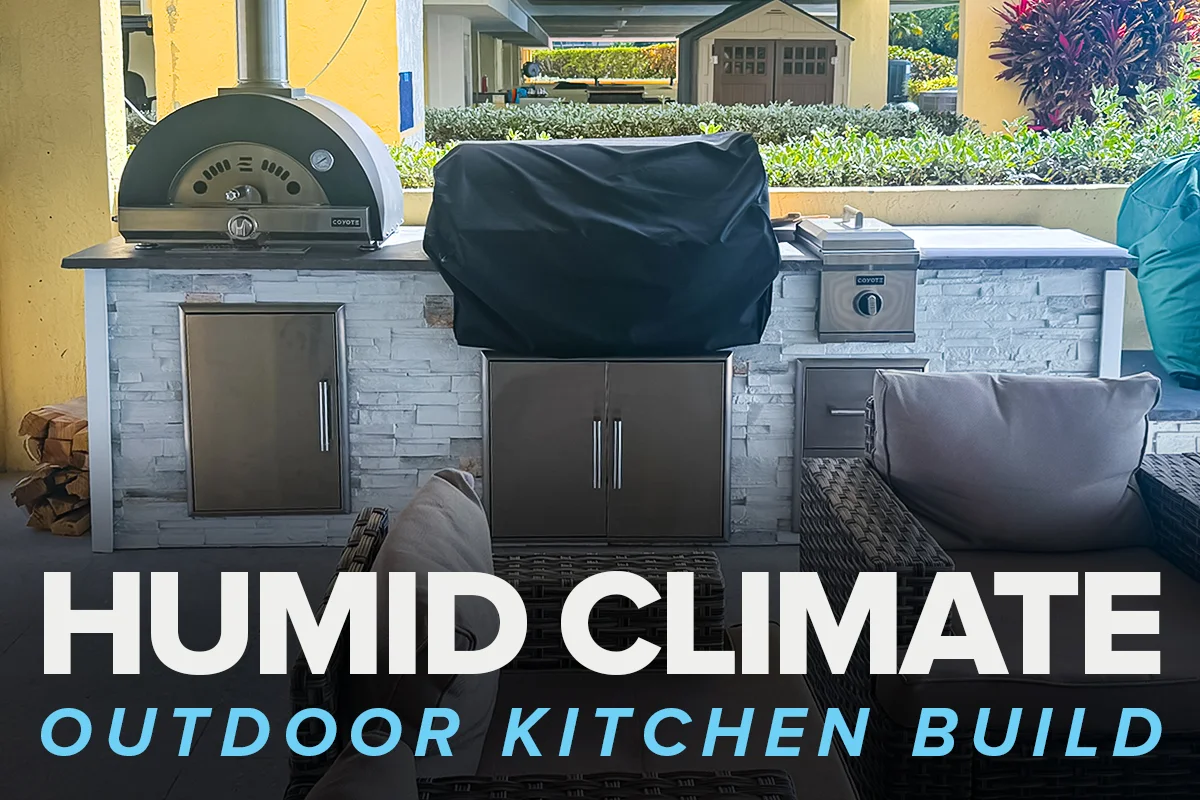
If you’re considering building an outdoor kitchen in a humid climate like Louisiana or Florida… you’ll have some particular things to keep in mind to make sure your grill island can handle all that ambient moisture!
Hence, why you’re searching for the best outdoor kitchen build for a humid climate.
As an outdoor kitchen manufacturer who delivers outdoor kitchens across the country (including super-humid climates)… we’ve learned a lot about what makes an outdoor kitchen project successful or unsuccessful in these areas.
In this article, you will learn what qualities make an outdoor kitchen good in a humid climate, what materials are best, what to avoid, and what build method is best for a humid climate.
What Qualities Make an Outdoor Kitchen Good in a Humid Climate?
An outdoor kitchen that’s designed to perform well in a humid climate will have these attributes:
- Resistance to Moisture Absorption: Of course, the biggest issue with humid climates is the constant exposure to moisture. Therefore, an outdoor kitchen build that is resistant to moisture absorption will perform better in a humid climate.
- Resistance to Excessive Heat: Most humid climates are hot and humid. When you’re dealing with excessive heat, it’s important to make sure your outdoor kitchen materials can withstand said heat.
- Resistance to Mold, Mildew, Rust, and Corrosion: Humid air is a breeding ground for mold and mildew… and it also makes any metal components susceptible to rust and corrosion. The ideal outdoor kitchen in a humid climate will not be susceptible to moisture-induced mold, mildew, rust, and corrosion.
What Outdoor Kitchen Materials are Best for a Humid Climate?
The two best outdoor kitchen materials to use in a humid climate are concrete masonry block or high performance concrete panels.
Concrete Masonry Block

Concrete masonry block, also known as CMU, is an outdoor kitchen structure built from cinder blocks. The cinder blocks are mortared together, and a finish is applied to the exterior (stucco, stone, and brick veneer are most common.)
Being made from concrete, CMU outdoor kitchens tend to fare extremely well in humid climates. Concrete in general doesn’t get damaged from excessive heat… and it’s immune to mold, mildew, rust, and corrosion damage. Although cinder blocks are porous and can absorb moisture, it is to a much lesser degree than the materials we suggest to avoid (more on that below).
High Performance Concrete Panels

High performance concrete panels are used in RTA’s outdoor kitchen line. This is a premium grade of concrete that is far stronger and more dense than traditional CMU construction. RTA Outdoor Living panels are completely structural and the finish is fully integrated, meaning this is a single-layer construction method.
All the aforementioned benefits of concrete also apply to high performance concrete: no heat damage, no mold, mildew, rust, or corrosion. Where high performance concrete gets an edge over cinder block is moisture absorption. Due to the high density of high performance concrete, this material is far less porous… which means far less moisture can get into this material, providing superior resistance in humid climates.

How Durable is High Performance Concrete… Actually?
What Outdoor Kitchen Materials Should You Avoid in a Humid Climate?
If you live in a humid climate, you should avoid using wood and metal frames with cement board for your outdoor kitchen build.
Wood

Wood is an absolute no-go in a humid climate for multiple reasons. Wood outdoor kitchens offer little to no resistance when it comes to warping, rotting, and swelling. Wood readily absorbs moisture, and in a humid climate… that only spells trouble for long-term damage.
In addition to this, wood is simply unsafe to use as a structural outdoor kitchen material. A grill with an open flame will be housed in this structure, posing a strong fire hazard! For this reason alone, avoid using wood in your outdoor kitchen at all costs.
Metal Frames / Cement Board

Although not as egregious as wood, metal framed outdoor kitchens with cement board are also problematic in humid climates. Metal framed outdoor kitchens are constructed with an aluminum or steel skeletal frame, covered with a layer of cement board, and then the finish material is applied to the exterior. (Stucco, tile, brick, and stone veneer are common finish materials.)
Just like with wood outdoor kitchens, moisture absorption is the metal framed outdoor kitchen’s downfall. Cement board in particular has a high moisture absorption rate, especially if it has contact with the ground… where it can wick up any water it comes in contact with. As cement board takes on moisture, it expands, exerting pressure on the metal frames and finish. This results in pieces of the finish cracking or falling off, allowing even more moisture to penetrate the structure. Over time, this moisture exposure will lead to the metal frames rusting or corroding… and left unchecked long enough, the entire outdoor kitchen could become structurally compromised.
What Qualities Make an Outdoor Kitchen Good in a Humid Climate?

Now that you’ve seen what qualities make an outdoor kitchen perform well in a humid climate, and what materials you should use or avoid… now you need to know what outdoor kitchen build method is best in a humid climate.
As mentioned earlier, CMU outdoor kitchens perform well in humid climates, although the concrete used can be porous. If you want the best-of-the-best for a humid climate, you truthfully cannot do better than a high performance concrete outdoor kitchen from RTA.
The high performance concrete used offers all the same weather resistance as regular concrete, but adds on a layer of high density… providing robust resilience to moisture absorption in humid climates. If you want an outdoor kitchen in a humid climate with the best chance for optimal longevity, this build method will be your best option.
And if you need more context on how durable high performance concrete actually is… this article will provide you with all the information you need. Enjoy the read, and we’ll catch you in the next one.