




If you’re building an outdoor kitchen in an exceptionally hot and dry climate like Arizona… you may be concerned about building an island that can truly last in your climate.
Which is why you’re asking: “What is the best outdoor kitchen build for a dry and hot climate?”
As an outdoor kitchen manufacturer that ships grill islands across the country (including dry and hot climates)… we’ve learned what qualities make an outdoor kitchen thrive in dry and hot climates.
In this article, you will learn what qualities make an outdoor kitchen good in a dry, hot climate, what materials are best, what materials you should avoid, and the best build method in your climate.
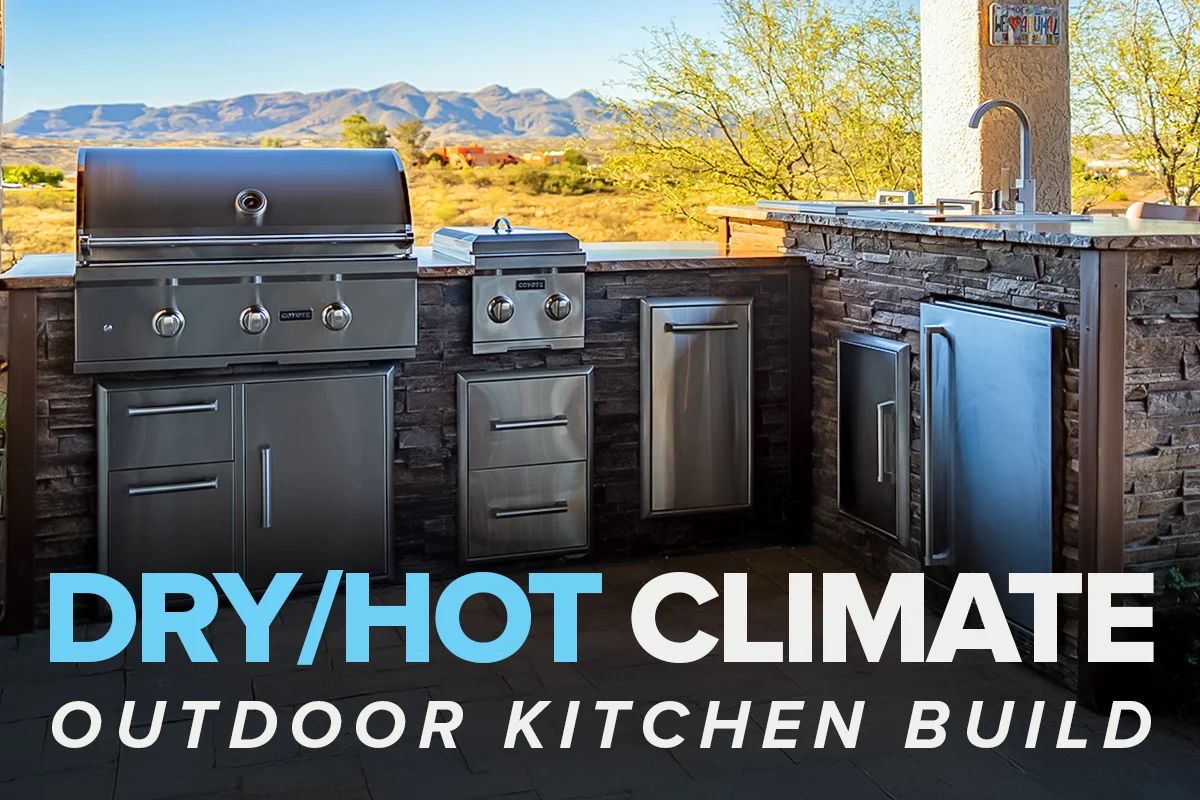
What Qualities make an Outdoor Kitchen Good in a Dry, Hot Climate?

The following qualities make an outdoor kitchen good in a dry, hot climate:
UV Resistance: In a dry and hot climate, your outdoor kitchen will constantly be battered with brilliant sunlight. For many outdoor kitchens, these intense UV rays can fade finishes and cause long-term damage. Ideally, your outdoor kitchen will have high UV resistance.
Excessive Heat Resistance: Some outdoor kitchen materials may warp or suffer long-term damage from constant exposure to excessive heat. Make sure your outdoor kitchen has high heat resistance before moving forward with a purchase.
Non-Combustible: In an environment with consistent dry heat, fire risk is of increased concern. For optimal safety, a high quality outdoor kitchen in your climate will be non-combustible.
What Outdoor Kitchen Materials are Best for a Dry, Hot Climate?
The best outdoor kitchen materials to use in a dry, hot climate are high quality stainless steel, concrete masonry, and high performance concrete.
High Quality Stainless Steel

When we refer to high quality stainless steel, we are specifically speaking of 304 grade or 316 grade stainless steel. These grades offer superior rust and corrosion resistance, which is an important factor even when you live in a dry climate.
Stainless steel outdoor kitchens won’t be damaged by intense UV rays or excessive heat, making it a great choice for the hot and dry climate. The only potential downside is that stainless steel does get incredibly hot to the touch under the sun, so if you go this route… you’ll likely be a lot happier if you install it under a shade structure like a gazebo or pergola. And if your stainless steel outdoor kitchen comes with a powder coated finish, make sure it is UV resistant.
Stainless steel outdoor kitchens are also made from a non-combustible material, so fire risk is low.
Concrete Masonry (CMU)

Concrete masonry blocks (also known as CMU) is a type of outdoor kitchen constructed with cinder blocks. These cinder blocks are mortared together to create the structure, and a finish is applied to the exterior. Common finishes include stucco, brick veneer, and stone veneer.
Overall, concrete masonry is exceptionally durable in hot and dry environments. It doesn’t get damaged by UV rays or excessive heat, and it is also a non-combustible material. Concrete is a better insulator than steel, so it will not get as hot under the sun as well.
High Performance Concrete

High performance concrete panels are used in RTA’s outdoor kitchen line. This is a premium grade of concrete that is far stronger and more dense than traditional CMU construction. RTA panels are completely structural and the finish is fully integrated, meaning this is a single-layer construction method.
So is it any better in a dry and hot climate than concrete masonry? To be truthful, there isn’t much of a durability difference between masonry and high performance concrete in your climate. However, due to the increased density of high performance concrete, if there is any moisture present in the air, it won’t get absorbed nearly as much as regular masonry concrete.
What Outdoor Kitchen Materials Should You Avoid in a Dry, Hot Climate?
Materials you should avoid in a dry and hot climate are wood, metal frames with cement board, and HDPE/PVC/plastic.
Wood

Wood is an absolute no-go in a dry and hot climate for one huge reason: safety. When consistently exposed to dry, hot air, the wood in your outdoor kitchen will become brittle. The more dry and brittle, the more like kindling it becomes. And since a wood outdoor kitchen will be housing a gas grill with an open flame… this setup puts you at extremely high risk of an outdoor kitchen fire. So for this reason alone, avoid wood in your outdoor kitchen at all costs!
Metal Frames with Cement Board

While it doesn’t pose a safety issue like wood, metal frames with cement board are also not ideal for use in a dry and hot climate. Metal framed outdoor kitchens are constructed with an aluminum or steel skeletal frame, covered with a layer of cement board, and then the finish material is applied to the exterior. (Stucco, tile, brick, and stone veneer are common finish materials.)
For the most part, these outdoor kitchen systems can fare decently well in a dry and hot climate… so why should you avoid them? The issue comes into play if any of these layers are compromised in one way or another. If your finish cracks or pieces fall off, any ambient moisture in the air will be invited into the interior. Cement board readily absorbs moisture, which will degrade the cement board… and also cause the metal frames to rust or corrode over time. Again, these materials aren’t the worst choice in a dry and hot climate, but there are better and more long-lasting solutions.
HDPE/PVC/Plastics

HDPE and PVC are both plastic-type materials that can be used in outdoor kitchen cabinetry. Although marine grade HDPE is a great choice in cold climates, it’s not a great choice in dry and hot climates.
This is because any outdoor kitchen made from a plastic material will be combustible. To help reduce safety risk, these kitchens require the use of insulated jackets with any cooking materials. In cooler climates, this is a great and workable solution… but in a dry and hot climate, it’s best to avoid the added risk coming from consistently hot weather.
In addition to this, some plastic outdoor kitchens are prone to warping in the presence of excessive heat, and some finishes may fade in the sun. A dry and hot climate provides the perfect conditions for this to occur.
What Outdoor Kitchen Build is Best in a Dry, Hot Climate?
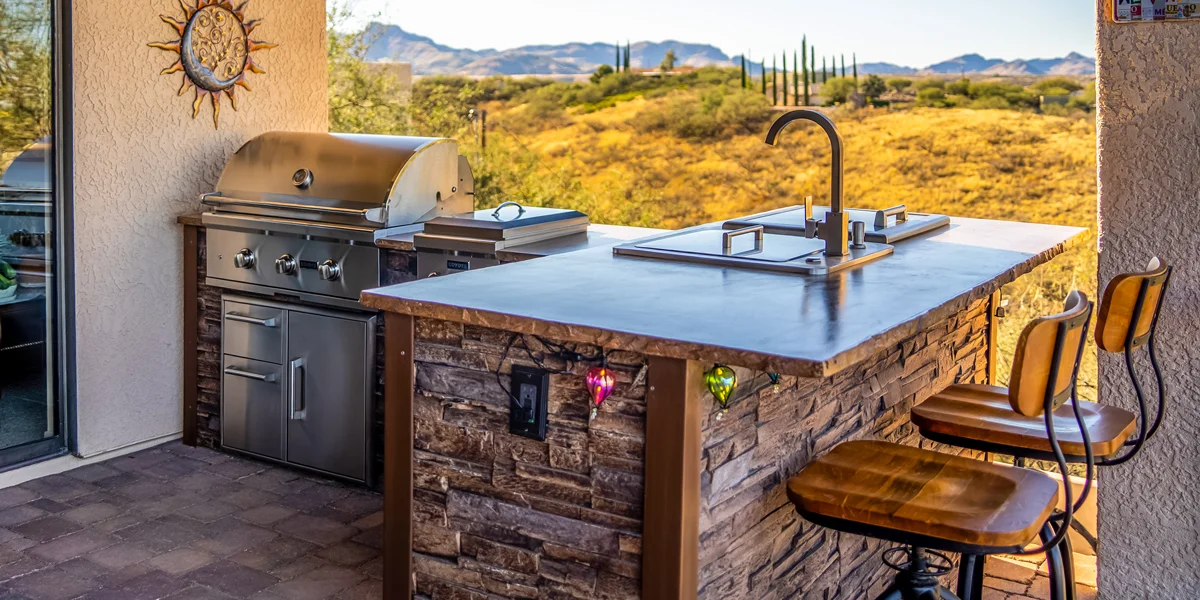
Now that you have an idea of what qualities make an outdoor kitchen perform well in a dry and hot climate, and what materials you should use or avoid… now you need to know what outdoor kitchen build method is best in a dry and hot climate.
As mentioned earlier, high quality stainless steel, concrete masonry, and high performance concrete will all be great options for you to consider.
If you want peak performance and optimal longevity, we’d suggest you consider high performance concrete in particular. This high density material is fully non-combustible, resistant to UV rays, and won’t get damaged from excessive heat exposure.
And if you need more context on how durable high performance concrete actually is… this article will provide you with all the information you need. Enjoy the read, and we’ll catch you in the next one.