


If you’ve begun to get a grasp on outdoor kitchen safety… you’ll understand how important proper island ventilation is. So with this concept in mind, you want to be sure the outdoor kitchen you build or purchase is properly ventilated.
Somewhere along the way, you may have heard that RTA outdoor kitchens exceed ventilation requirements for Coyote appliances. You may be wondering why we go beyond the minimum requirements. In this article, you will learn exactly why that is!
Quick Links:
What are the Minimum Outdoor Kitchen Ventilation Requirements for Coyote Appliances?
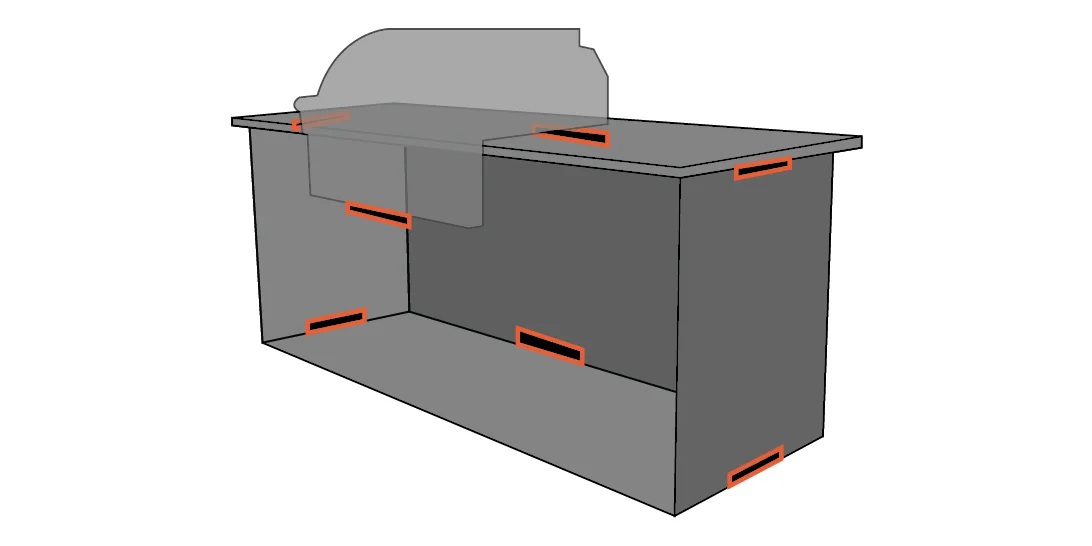
For an outdoor kitchen that houses Coyote appliances, the following ventilation requirements must be met:
- Includes a minimum of 2 vents (but 4 is stated as optimal)
- 20 square inches of space per vent
Below is how much ventilation is included in each RTA outdoor kitchen:
- Top and bottom vents on 3 sides of each island structure (both sides and the back)
- Small ventilation gap below each cooking appliance (approximately ¼”)
- Each side vent includes 10 square inches of ventilation, and each back panel vent includes 22 square inches of ventilation (total of 84 square inches of ventilation)
Why do RTA Outdoor Kitchens Exceed Appliance Ventilation Requirements?

As you’ve seen above, RTA outdoor kitchens significantly exceed Coyote’s ventilation requirements. Why is this?
- Overengineered is better than underengineered: There’s no reason not to have extra ventilation, so why not add it? The extra ventilation is also helpful in the event that some of your vents get blocked with leaf litter or outdoor debris without you realizing it.
- Allows for compatibility with both liquid propane and natural gas appliances: Liquid propane gas is more dense than air, causing it to sink. Natural gas is the opposite: it is less dense than air and will rise. Normally, ventilation will be located according to the fuel type you plan to use in your outdoor kitchen. We figure there’s no harm in having both! Plus, if you decide to switch fuel types in the future, this will make your outdoor kitchen ventilation future-proof.
Interested in Learning More about RTA Outdoor Living?

Now that you’ve learned more about Coyote’s ventilation requirements for an outdoor kitchen, and why RTA Outdoor Living exceeds them… you may be interested in learning more about RTA outdoor kitchens for your own backyard project.
If so, the best place to get started is through RTA Outdoor Living’s Learning Hub. This is a central location where you can find anything and everything you’d want to know about RTA outdoor kitchens! (Or even just outdoor kitchens in general.)
Enjoy exploring the Learning Hub, and we’ll catch you in the next one.

