


If you’re planning to build an outdoor kitchen on the coastline… you’ll know there are certain challenges you’ll have to keep in mind as you build!
Hence, why you’re wondering: “What is the best outdoor kitchen build for a coastal climate?”
As an outdoor kitchen manufacturer who delivers outdoor kitchens across the country (including coastal climates)… we’ve learned a lot about what makes an outdoor kitchen project successful or unsuccessful in these areas.
In this article, you will learn what qualities make an outdoor kitchen good in a coastal climate, what materials are best, what to avoid, and what build method is best for a coastal climate.
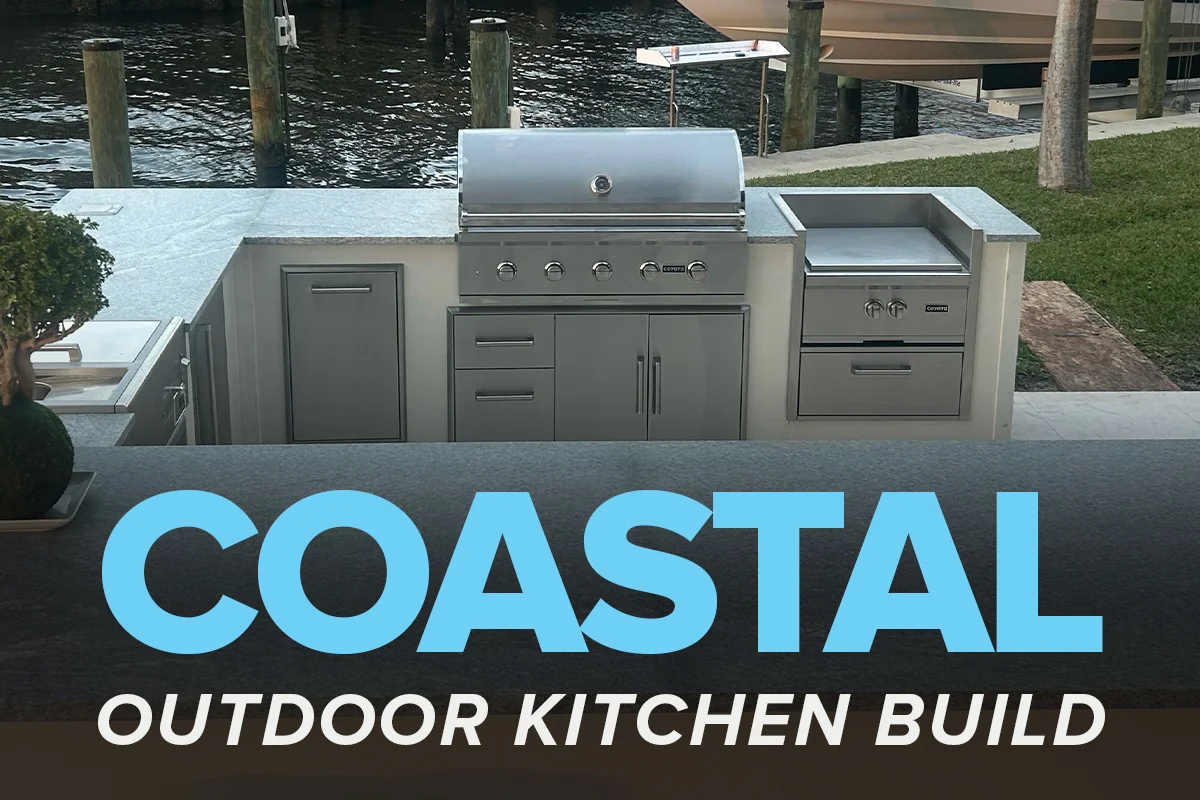
What Qualities Make an Outdoor Kitchen Good in a Coastal Climate?

An outdoor kitchen that’s designed to perform well in a coastal climate will have these attributes:
- Resistance to Moisture Absorption: Of course, a primary issue with coastal climates is the constant exposure to moisture. Therefore, an outdoor kitchen build that is resistant to moisture absorption will perform better in a coastal climate.
- Resistance to Excessive Heat or Cold: The United States coastline covers a wide swath of different temperature ranges! From the Pacific Northwest, all the way down to the Gulf Coast, and back up to the rocky shorelines of Maine… a wide range of ambient temperatures cover this area. If you live in a hot coastal climate like Florida, you’ll need an outdoor kitchen that is heat-resistant. If you’re up in Maine, you’ll need an outdoor kitchen that can handle freezing temperatures, snow, and ice as well.
- Resistance to Mold and Mildew: Coastal climates are humid, which makes them a breeding ground for all manner of mold and mildew. The ideal outdoor kitchen solution will not be susceptible to moisture-induced mold and mildew growth.
- Resistance to Rust and Corrosion: The most unique challenge of coastal environments is that salty, oceanside air. The closer you are to the water, the more prevalent this problem is. As such, you need an outdoor kitchen that won’t rust and corrode when constantly exposed to salty ocean air.
What Outdoor Kitchen Materials are Best for a Coastal Climate?
The two best outdoor kitchen materials to use in a coastal climate are high performance concrete panels and HDPE panels.
High Performance Concrete Panels

High performance concrete panels are used in RTA’s outdoor kitchen line. This is a premium grade of concrete that is far stronger and more dense than traditional CMU construction. RTA panels are completely structural and the finish is fully integrated, meaning this is a single-layer construction method.
This material is exceptionally dense, and has low moisture absorption. This virtually eliminates any issues related to moisture absorption from humidity and freeze-thaw cycles. Additionally, concrete in and of itself is immune to mold, mildew, rust and corrosion. High performance concrete is essentially non-reactive in all climates, whether you live in a humid coastal climate or a cold coastal climate.
HDPE

HDPE (high density polyethylene) is a type of plastic used by some outdoor kitchen brands for their product line. You may see panel style HDPE that locks together (like RTA’s MOKs system) or more traditional style outdoor kitchen cabinetry that makes use of HDPE. This material is most commonly used in marine applications due to its extreme durability in the presence of moisture.
As such, HDPE is an excellent choice for outdoor kitchens in coastal climates. This material is 100% nonporous, which means there is no opportunity for moisture to penetrate it. This makes HDPE immune to moisture absorption issues, mold, mildew, rust, and corrosion. Similar to high performance concrete, HDPE will perform well in hot coastal and cold coastal climates alike.
The only thing to note about HDPE is that it is a combustible material. So because HDPE outdoor kitchens will house a grill with an open flame… you need to make sure you use insulated jackets with any and all cooking appliances for heat protection.
Wood

Wood is an absolute no-go in a coastal climate for multiple reasons. Wood outdoor kitchens offer little to no resistance when it comes to warping, rotting, and swelling. Wood readily absorbs moisture, and in a humid coastal climate… that only spells trouble for long-term damage.
In addition to this, wood is simply unsafe to use as a structural outdoor kitchen material. A grill with an open flame will be housed in this structure, posing a strong fire hazard! For this reason alone, avoid using wood in your outdoor kitchen at all costs.
Metal Frames with Cement Board

Although not as egregious as wood, metal framed outdoor kitchens with cement board are also problematic in coastal climates. Metal framed outdoor kitchens are constructed with an aluminum or steel skeletal frame, covered with a layer of cement board, and then the finish material is applied to the exterior. (Stucco, tile, brick, and stone veneer are common finish materials.)
Just like with wood outdoor kitchens, moisture absorption is the metal framed outdoor kitchen’s downfall. Cement board in particular has a high moisture absorption rate, especially if it has contact with the ground… where it can wick up any water it comes in contact with. As cement board takes on moisture, it expands, exerting pressure on the metal frames and finish. This results in pieces of the finish cracking or falling off, allowing even more moisture to penetrate the structure. Over time, this moisture exposure will lead to the metal frames rusting or corroding… and left unchecked long enough, the entire outdoor kitchen could become structurally compromised.
What Outdoor Kitchen Build is Best in a Coastal Climate?

Now that you’ve seen what qualities make an outdoor kitchen perform well in a coastal climate, and what materials you should use or avoid… now you need to know what outdoor kitchen build method is best in a coastal climate.
If you want the best-of-the-best for a coastal climate, you truthfully cannot do better than a high performance concrete outdoor kitchen from RTA.
The high performance concrete used offers all the same weather resistance as regular concrete, but adds on a layer of high density… providing robust resilience to moisture absorption in humid coastal climates. If you want an outdoor kitchen in a coastal climate with the best chance for optimal longevity, this build method will be your best option.
And if you need more context on how durable high performance concrete actually is… this article will provide you with all the information you need. Enjoy the read, and we’ll catch you in the next one.