


As you begin to contemplate what materials are best to build your outdoor kitchen from… you’re going to come across 3 primary options: wood, metal frames, and concrete.
So of course, you want to know: “Is concrete good for an outdoor kitchen?”
As a manufacturer of high performance concrete outdoor kitchens, we have a deep understanding of the topic… but we also recognize that the information we share can come off as biased, because we sell concrete outdoor kitchens. In order to reduce bias as much as possible, we’ve taken care to share just the facts about concrete outdoor kitchens so you can make an educated decision. We also discuss other types of concrete outdoor kitchens beyond RTA Outdoor Living, so you can get the full picture.
In this article, you’ll learn whether or not concrete is a good material for an outdoor kitchen, and why it’s worth considering a concrete outdoor kitchen. By the end, you’ll have a good understanding of how concrete performs as an outdoor kitchen material… and whether or not it’s the right choice for you.
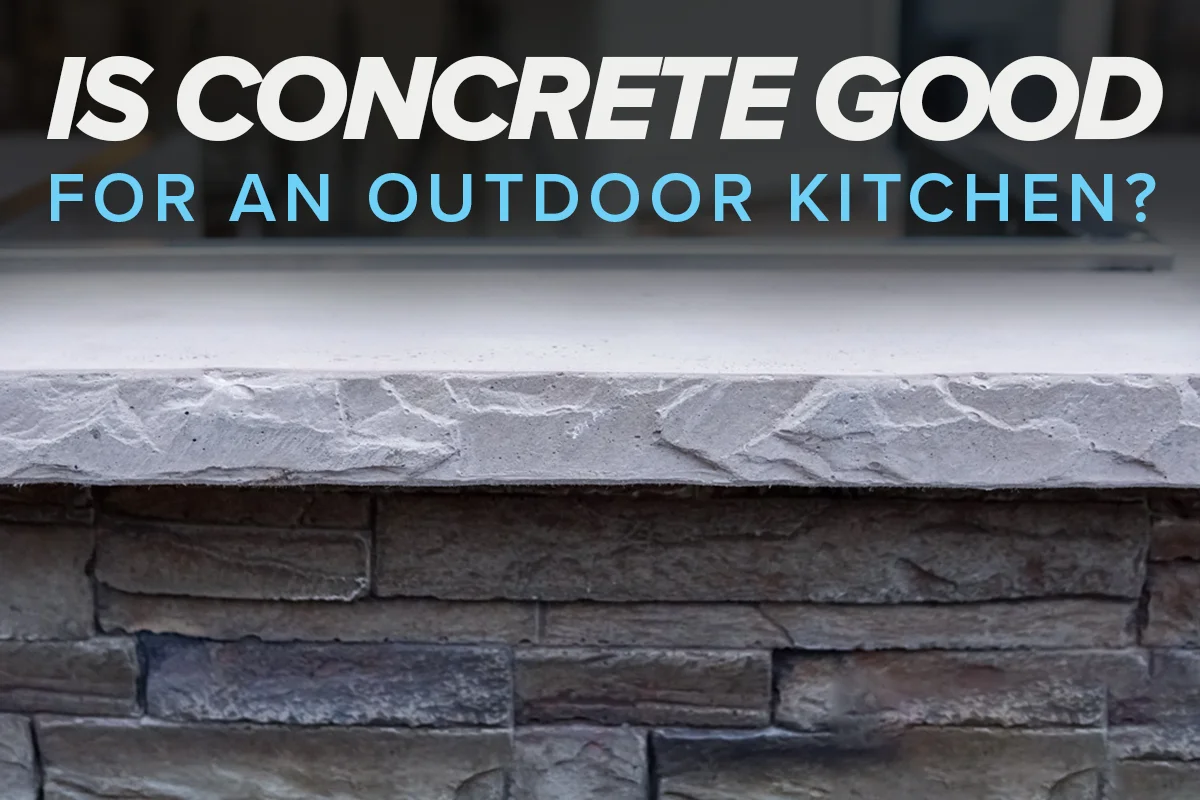
Is Concrete Good for an Outdoor Kitchen?
Yes, concrete is an excellent material to use for an outdoor kitchen. Compared to other traditional methods of outdoor kitchen construction (wood, metal frames) concrete tends to have the best performance overall.
Why Should I Consider Using Concrete for My Outdoor Kitchen?
Concrete is a great choice for an outdoor kitchen build due to its durability, strength, longevity, weather resistance, non-combustibility, and resistance to insect damage.
There are different types of outdoor kitchen concrete, as well. The most common forms you will encounter are RTA’s high performance concrete, or CMU (concrete masonry unit) construction. There are performance differences between the two, which will be discussed in each category below.
Concrete Offers Superior Durability & Strength

When you’re making an investment into an outdoor kitchen… the last thing you want is something that will start to break apart in a couple years! When it comes to outdoor kitchen materials, concrete is the strongest and most durable of them all.
RTA Outdoor Living’s concrete outdoor kitchens are made from high performance concrete panels. These panels are 1.5” thick, completely structural, and rated for 17,000 PSI. (The countertops are 1.25” thick.)
To contrast, most traditional concrete used in sidewalks and the like is rated for only 3,500 PSI. This is generally the form of concrete used in CMU outdoor kitchens. These outdoor kitchens are constructed from cinder blocks as a base, coated with mortar, and a finish such as stone or brick veneer is applied to the outside. With outdoor kitchens using traditional concrete, the walls need to be 3.5”-4” to be considered structurally sound. (This includes filling in cinder block gaps with more concrete.) Some contractors may put additives into their concrete mix to increase the strength to 4,500-5,000 PSI, but this significantly increases the cost on their end and is uncommon to see.
You’ll notice that RTA’s concrete is significantly stronger than CMU. Does this mean CMU is no good? While it’s true that the concrete used in CMU is not nearly as strong… much of their strength comes from the concrete blocks being mortared together to create a single, solid unit. So while RTA concrete is overall stronger and more durable, a fully constructed CMU kitchen will still be far stronger than an island made from wood or metal frames.
You’ll Get Optimal Longevity from a Concrete Outdoor Kitchen

There’s a reason why concrete is a trusted material in all forms of infrastructure. It’s strong, it’s durable… and it lasts an exceptionally long time. When properly constructed, concrete is extremely unlikely to fail and can be relied upon for decades of solid performance.
In the case of an outdoor kitchen, the concrete used in RTA outdoor kitchens is rated for 100 years. When built into an outdoor kitchen, we estimate an RTA outdoor kitchen could easily last 20 years or more, even if maintenance is neglected. With regular maintenance and countertop resealing, you’ll likely get an additional 10-20 years without issue.
Outdoor kitchens made from concrete block will have a similar lifespan. They may fail a bit earlier due to weaker concrete and layered construction… but overall, in terms of structural integrity, there’s little that can go wrong with a CMU outdoor kitchen.
Whereas, at the maximum, you can expect a metal framed outdoor kitchen to last in the neighborhood of 10 years. If you live in a high-moisture area, you’ll likely only get 5-6 years of good use.
Concrete Grill Islands Provide the Best Weather Resistance

Here’s the thing about concrete: once you pour it and it cures… it just stays there, and it seems like nothing can touch it. Rain, high humidity, UV rays, excessive temperature swings, ice, snow, hail, and high winds do not affect concrete in any impactful way. And since your outdoor kitchen will be exposed to these elements on a constant basis, it’s good to use a material that’s as close to weatherproof as possible.
Once again, there is a performance difference between high performance RTA concrete and CMU concrete. RTA concrete outdoor kitchens were specifically engineered to withstand the northern New England environment, which is among the harshest in the country. High winds, frequent snowfall, hail, rain, ice, and single-day temperature fluctuations of 40 degrees or more are not uncommon. RTA’s high performance concrete is dense and does not readily absorb moisture, which protects it from damage during frequent freeze-thaw cycles. Because it doesn’t absorb moisture well, there’s no water in the panels to freeze into ice, preventing cracks and other damage.
Concrete blocks are also highly weather resistant, but their multi-layered construction can prove problematic if you live in an area that frequently toggles between freezing and above-freezing temperatures. Concrete blocks are more porous, and can absorb moisture. With frequent freezing and thawing, this causes the layers of the CMU outdoor kitchen to expand and contract, exerting outward pressure between them. This can cause pieces of the finish to pop off or crack, and could cause some structural damage depending on how much moisture absorption there is.
All in all, if you want the highest degree of weather resistance, RTA concrete will be the stronger choice in this category.
Concrete Outdoor Kitchens are Non-Combustible

Safety is another component of outdoor kitchen construction that’s not discussed enough. Common materials like wood are highly combustible, which when paired with an open-flame grill, creates a fire hazard for your backyard.
A huge benefit of using concrete in your outdoor kitchen is that it’s non-combustible. If the unfortunate grease fire breaks out, you won’t have to worry about your outdoor kitchen structure going up in flames, making the situation 10x worse.
That said, non-combustibility isn’t the only component of outdoor kitchen safety. Outdoor kitchens have also been known to explode if there was not enough ventilation built into the island structure. RTA outdoor kitchens account for this with ventilation in 7 unique locations… but not all CMU builders will factor this into their plans. If you decide to go down the concrete block route, make sure your builder is meeting or exceeding your appliance manufacturer’s guidelines for ventilation requirements.
You’ll Get High Resistance to Insect Damage

If you live in a region with high termite pressure… you’ll also want to make sure you use an outdoor kitchen material that won’t get eaten from the inside out. For this, of course, wood is a no-go!
Unsurprisingly, concrete is completely unappealing to termites and other damage-causing insects. So if you have concerns about this, concrete is the way to go.
Is a Concrete Outdoor Kitchen Right for Me?

At this stage, you should have a good understanding of whether or not concrete is a good outdoor kitchen material, and the reasons why it’s worth using in an outdoor kitchen. You know the benefits now… but you’re wondering, is it really right for me?
You should build an outdoor kitchen from concrete if:
- You want a strong and durable outdoor kitchen
- You want your outdoor kitchen investment to last as long as possible (you don’t want a short-term solution)
- You live in a harsh climate that’s destructive to most common building materials
- You want to use non-combustible materials
- You live in an area with termite pressure
- You’re willing to pay more for higher quality materials and craftsmanship
If you find yourself nodding in agreement with all the above points, and you’re feeling like concrete is the right choice for your outdoor kitchen… your next question is likely to be: “What’s all this going to cost?” The answer you’re looking for is right in this blog, which explains exactly what a concrete outdoor kitchen from RTA is likely to cost. Enjoy the read, and if you have any questions… we’re only a phone call or email away.