


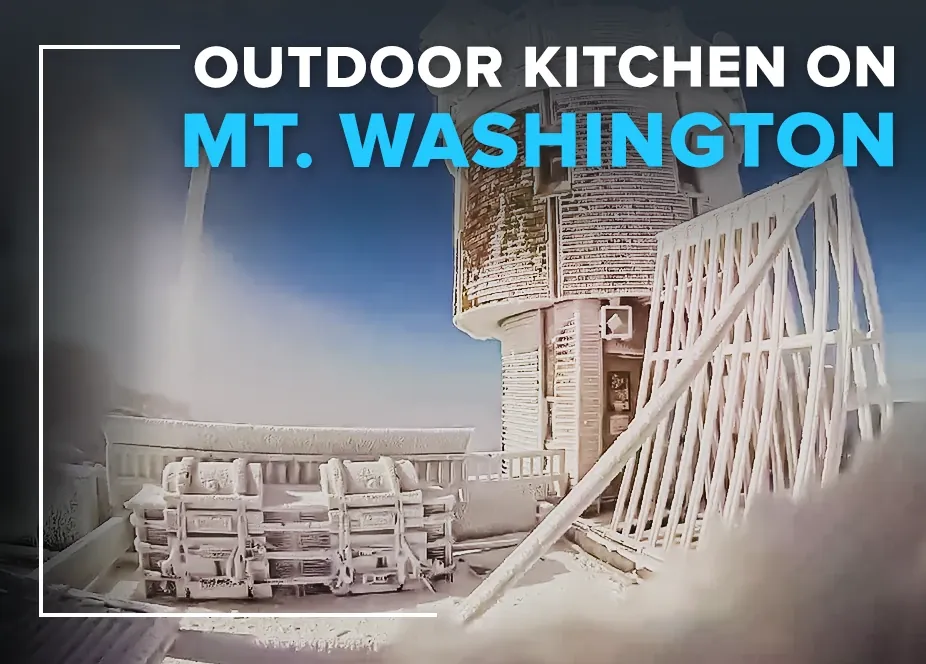


If you’ve been researching how to build an outdoor kitchen… odds are, you’ve mostly encountered projects that involve traditional outdoor kitchen construction. This system involves metal or wood frames, cement board sheathing, a cladding material, and then a finish material such as stucco, brick, or stone.
It’s still the most dominant method for building an outdoor kitchen… so what could be so wrong with it? Well, unfortunately, there is a key issue with traditional outdoor kitchen construction. As an outdoor kitchen manufacturer ourselves, we’ve deeply analyzed how an outdoor kitchen build may fail, and have engineered our product specifically to avoid these problems.
In this article, you will learn about the main problems with traditional outdoor kitchen construction, and a worthy alternative to consider.
The Crux: A Multi-Layered System

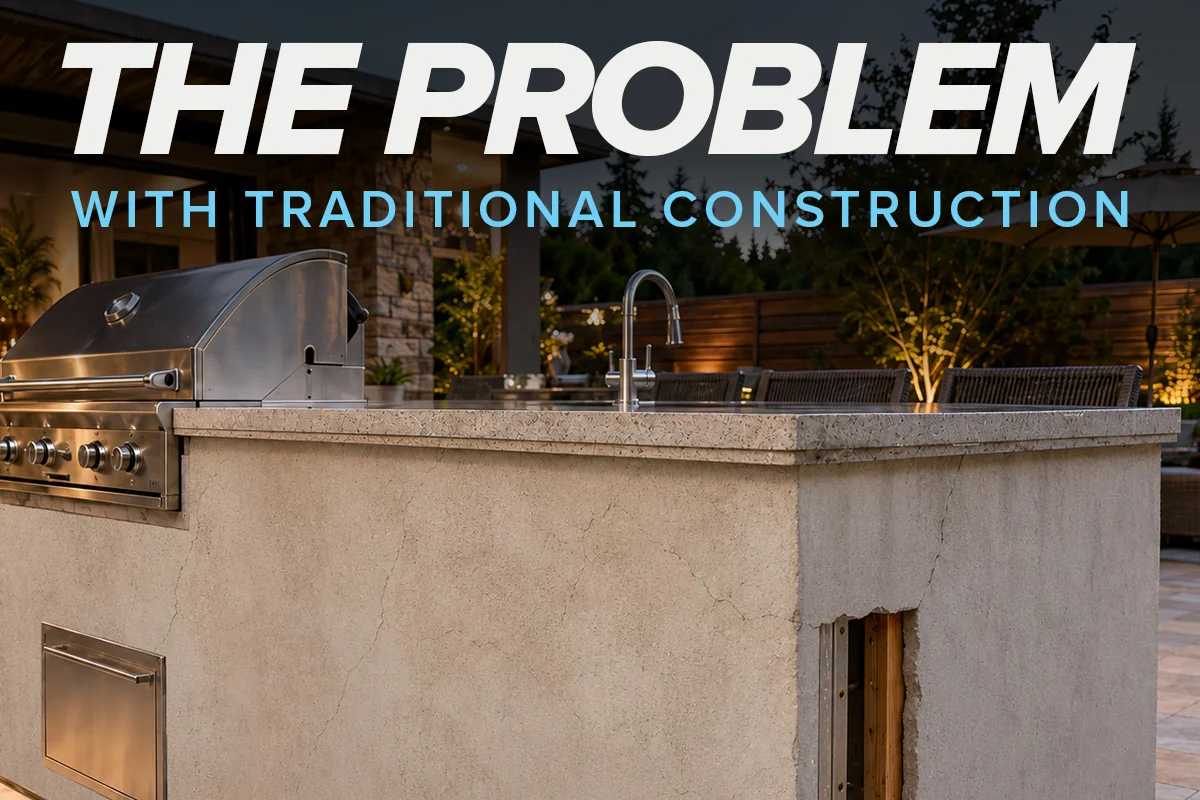
The problem with traditional outdoor kitchen construction can all be boiled down to one thing: the fact that it is a multi-layered system. As mentioned in the introduction, traditional outdoor kitchens are built from multiple layers: wood or metal frames, cement board sheathing, cladding material, and the finish material.
Why is this a problem, exactly?
- Every Layer Introduces an Additional Potential Point of Failure: For better or for worse, every layer involved with constructing an outdoor kitchen creates an additional potential point of failure. Your metal frames might be solid, but what if the cement board fails? Then your cladding material and finish will fail too, and you’re back at square one, having to rebuild the entire outdoor kitchen.
- Each Layer is Composed of Different Materials: While each material involved in the construction of a traditional outdoor kitchen serves a particular purpose… the issue here is that they will all behave wildly differently in the outdoor environment. Wood can rot, swell, and burn, cement board can readily absorb moisture, stucco can crack… which creates stress on the remaining layers. If a wooden frame starts swelling and warping, that is going to damage all 3 other layers, whether they were directly impacted by weather conditions or not.
- Each Layer Has Susceptibilities and Weak Points: Similar to the previous point, each layer involved with traditional outdoor kitchen construction will have unique susceptibilities and weak points. As such, the overall risk of something going wrong over time increases, as there is more potential for one of the layers to get damaged.
- Traditional Builds Have No Standard for Construction: All traditional builds feature the same multi-layered system, but you may see the materials used can vary widely. Wood, metal, masonry, etc. This inconsistency of materials used reveals that there is no current standard or “best practices” for traditional outdoor kitchen construction. Depending on who you work with, the quality and workmanship of the final product is likely to be a mixed bag!
- Delamination: Due to the nature of a multi-layered outdoor kitchen system, its biggest weakness is the risk of delamination. This is especially true if you live in a flood prone, high humidity, or freeze thaw climate. When moisture is pulled into the outdoor kitchen (usually through cement board), this absorption causes the layers to expand. As expansion occurs, pressure is exerted on the other layers of the island, leading to damage over time. For metal frames, this can lead to rusting and corrosion… and for the finish, this can lead to cracked stucco or pieces of stone veneer popping off.
What’s the Alternative to Traditional Outdoor Kitchen Construction?
Now that you understand the critical issue with traditional outdoor kitchen construction… what’s the alternative?
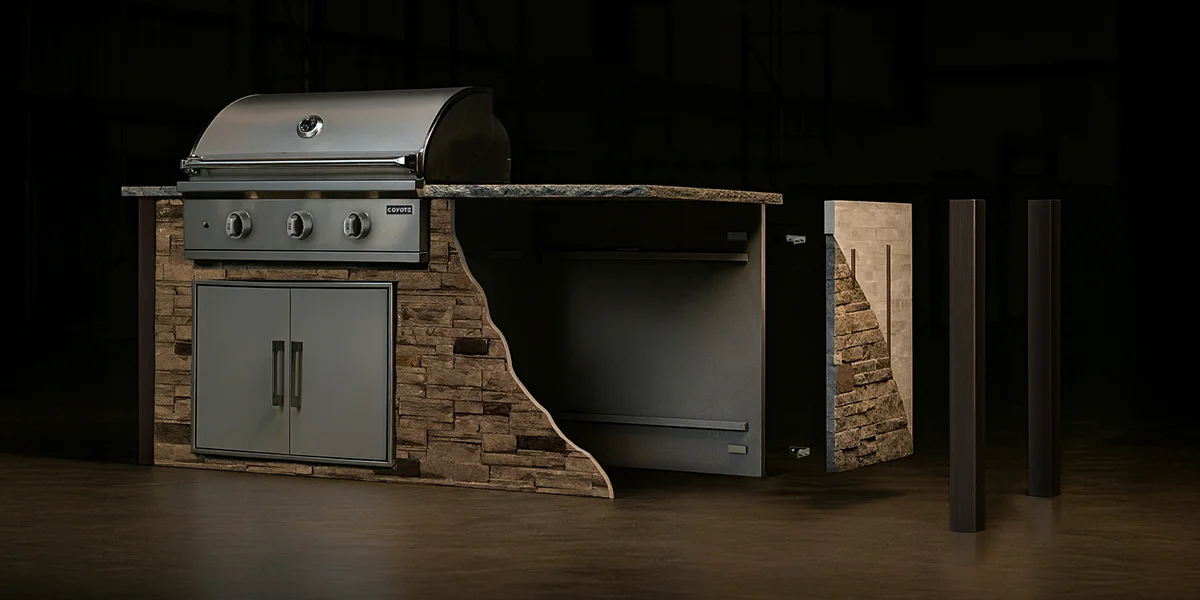
As you’ve seen, the primary issue is the multi-layered system. If you get rid of all the layers, you eliminate the problem. Therefore, your best bet is to work with an outdoor kitchen company that offers single-layered construction methods, such as RTA Outdoor Living.
For the sake of example, RTA outdoor kitchens are:
- Made with a single layer of high performance concrete
- The finish is fully integrated into the structure, so cracks and pieces falling off are not possible
- Being a single-layer system, there is no risk of delamination
- High performance concrete is the only material used, and it is hardy in all climates (won’t rust, corrode, swell, warp, rot, etc.)
If you like the sound of what the RTA system can provide you with… a great place to start is by whipping up a design. Our free online design tool will allow you to draft up a dream design, and from there, you can speak directly with our team about whether or not RTA is the right fit for you. So start your design, and we hope to hear from you soon!