


As you continue to research which outdoor kitchen solution is best for you… undoubtedly, a big topic you’re going to stumble upon is material content.
What are all of these outdoor kitchens made of? Are the materials any good? Why do these companies use what they use?
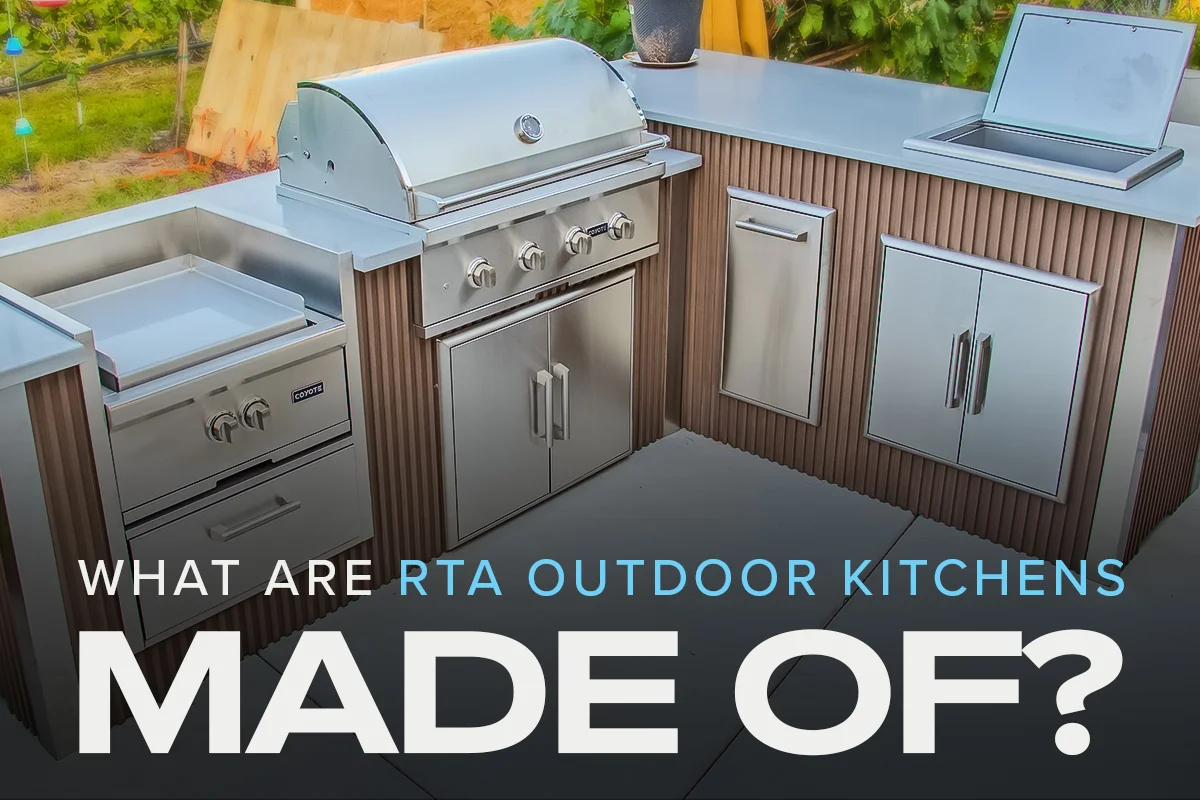
And more specifically, in this case… “What are RTA outdoor kitchens made of?”
Since we at RTA Outdoor Living are the inventors of what has become ready to assemble outdoor kitchens, we’ve got plenty of experience to speak on this!
In this article, we will highlight the exact materials of RTA outdoor kitchens. We’ll explain what all components of an RTA outdoor kitchen are made from and why we use them. By the end, you’ll have a clear understanding of what materials RTA uses, why they’re used, and how it benefits your outdoor kitchen project.
What are RTA Panels Made from?
RTA kitchen panels are made with high performance concrete reinforced with microfibers.
And just for clarity: when we refer to RTA panels, we are describing the 4 outer walls that make up the structure of an RTA outdoor kitchen.
What Is High Performance Concrete?

As you might guess from the name, high performance concrete is much different than regular concrete! We use high performance concrete because this material is what defines and makes the RTA system possible.
What does this mean? Well, as you may have seen… RTA outdoor kitchens are designed with single-layer construction. The finish is fully integrated into the panel, and the panel itself is structural. So you don’t need to fuss with layers of frame, cement board, and a hand-applied finish. It’s seamless.
With regular concrete, it’s impossible to get a thin, structural panel that can be maneuvered well. RTA’s high performance concrete panels only need to be 1”-1.5” thick in order to be considered structural. Whereas, regular concrete needs to be 3”-4” thick in order to be considered structural… which is simply not feasible to carry and move around for DIY installation.
A key benefit of high performance concrete is its density. This material is far more dense than standard concrete, which means it’s less porous and much less affected by moisture damage. Because of this RTA panels won’t expand and contract when exposed to moisture, because it is relatively non-porous. This increased density also makes RTA panels more resistant against unsightly pitting and cracking that you’ll see with regular concrete. (RTA panels stay pristine!)
And if you’re wondering about the microfibers… this addition simply makes the high performance concrete mixture even stronger than it already is.
Do Outdoor Kitchen Materials Matter That Much?
What are RTA Countertops Made from?
RTA outdoor kitchen countertops are made with high performance concrete. This is further reinforced with microfibers and composite rebar.
RTA also offers granite countertops from a local fabricator.
Why Do We Use These Materials?
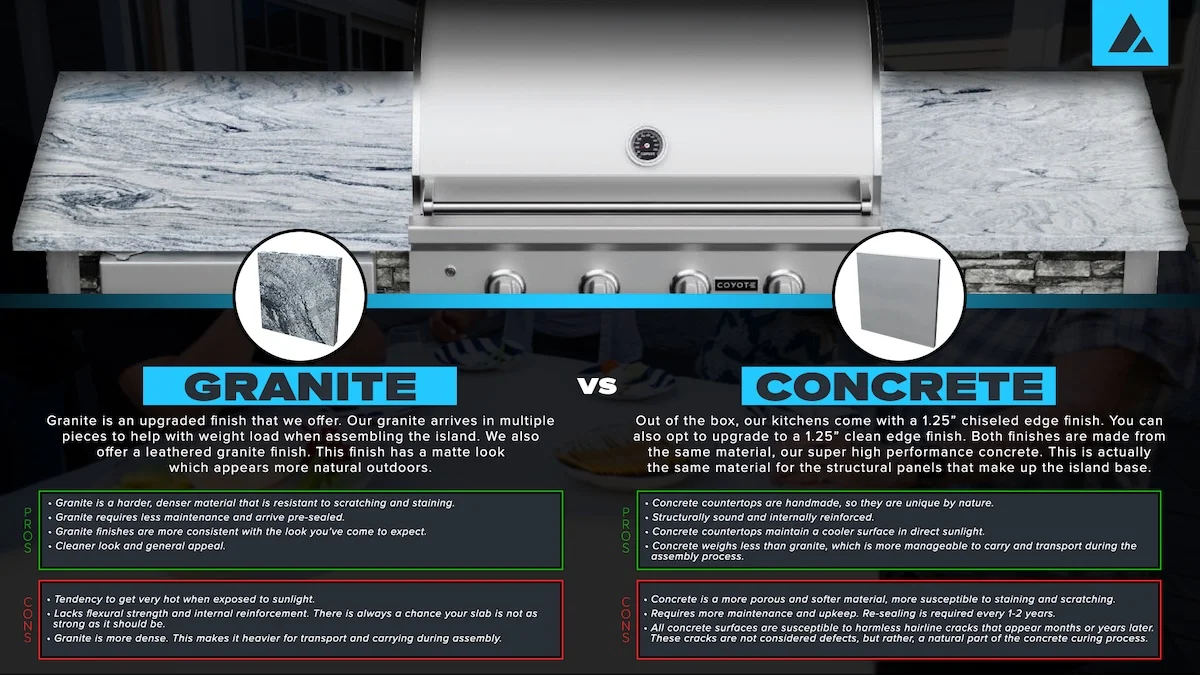
You’ll notice that RTA countertop materials are virtually the same as the panels… but also include composite rebar. Why is that? Well, horizontal surfaces generally take more of a beating than vertical ones. On top of that, concrete generally doesn’t have the greatest flexural strength (resistance to bending before it cracks or breaks). The addition of composite rebar helps with flexural strength and further improves durability.
There’s also a reason why we use composite rebar instead of steel. As you know, metal can rust and corrode! And although high performance concrete is resistant to moisture, it’s certainly not waterproof. If steel rebar was used, it would rust and corrode over time. This oxidation creates rust, which takes up more volume than the original steel. This expansion exerts pressure on the concrete, and eventually, the countertop will crack or spall. (Spalling refers to flaking, chipping, and pieces breaking off the surface of concrete.)
Composite rebar, on the other hand, cannot rust or corrode. So by using this material in RTA countertops, this issue is completely avoided.

You can also opt for granite countertops with an RTA outdoor kitchen, which is a classic choice for interior kitchens as well! Granite is an extremely dense stone that is highly scratch and stain resistant (more so than concrete). However, it can split or crack due to a lack of flexural strength.
What Materials Are Used in Appliances For RTAOutdoor Kitchens?
Although we don’t manufacture our own appliances… RTA outdoor kitchen kits do come with appliances from Coyote Outdoor Living, so it makes sense to mention them here.
Coyote appliances are made with 304 grade stainless steel.
Why Choose 304 Grade Stainless Steel?

Simply put, 304 stainless steel is the highest grade of steel that balances both durability and price.
Many other gas grills and outdoor appliances will contain 430 stainless steel. This grade of steel may be more affordable, but it is also highly prone to rust and corrosion. This is more headache and maintenance for you!
On the other side of the spectrum, many appliance manufacturers offer 316 stainless steel as an upgrade option. This is a marine-grade steel which is extremely rust and corrosion resistant. This material is best for those living in oceanside environments where corrosion is a common problem. However, the price can be exorbitantly expensive. Most 316 grade grills will cost 3-4x 304 grade steel.

304 grade stainless steel sits in the middle. It’s much more durable than 430 grade, and perfectly suitable in nearly all environments. You’ll get years of worry-free use. At the same time, the price point remains in a far more reasonable range than 316 grade steel.
What Happens If You Use Lesser Quality Materials?
Now that you’ve learned (a) what RTA outdoor kitchens are made from and (b) why we use the materials we do… hopefully, you can see how much thought goes into an RTA outdoor kitchen, and how these material choices benefit your project.
In order to show our point as well as tell it… the video above does an excellent job of illustrating why your outdoor kitchen material choice is crucial.
Several years back, the Tillman family had an outdoor kitchen built by their local contractor. It got the job done, but when it came time to replace it… the Tillmans discovered some shocking problems during demolition. You’ll see the details in the video, but let’s just say, they were relieved to be replacing their old outdoor kitchen with an RTA one!
Enjoy the video, and we’ll catch you in the next article.